
I’m not gonna lie, I was scared to write this review. That’s why I put it off so long. This movie’s been out forever, but it’s been in the back of my mind since day one. I’ve watched it five times. It just destroyed me on viewing five like it was the first.
I can put it off no longer.
Ryan Coogler wastes no time with Sinners. The carvings used in the opening sequence immediately communicate the importance of music on this particular journey. With that, we’re dropped into 1930s Clarksdale, Mississippi, alongside Sammie, who is heading to church. Once he gets out of his car, we can see that Sammie is in rough shape. He’s got what looks like a piece of a guitar grasped firmly in his right hand. Inside, Sammie finds a packed church with his father, the preacher, at the helm. Before checking on Sammie, his father has already begun to make an example out of him. As he berates him for hearing the “call of sin,” we get flashes of an evil-looking man with red eyes. It’s jarring and ominous. Ultimately, his father embraces him as he speaks about salvation. Once he’s got him in his grasp, the preacher demands that Sammie leave his “sinning ways where they lie.” His father tells him to drop that guitar. Sammie has reached a pivotal moment in his life, and just as he does, the blues pierces through and the storytelling begins.
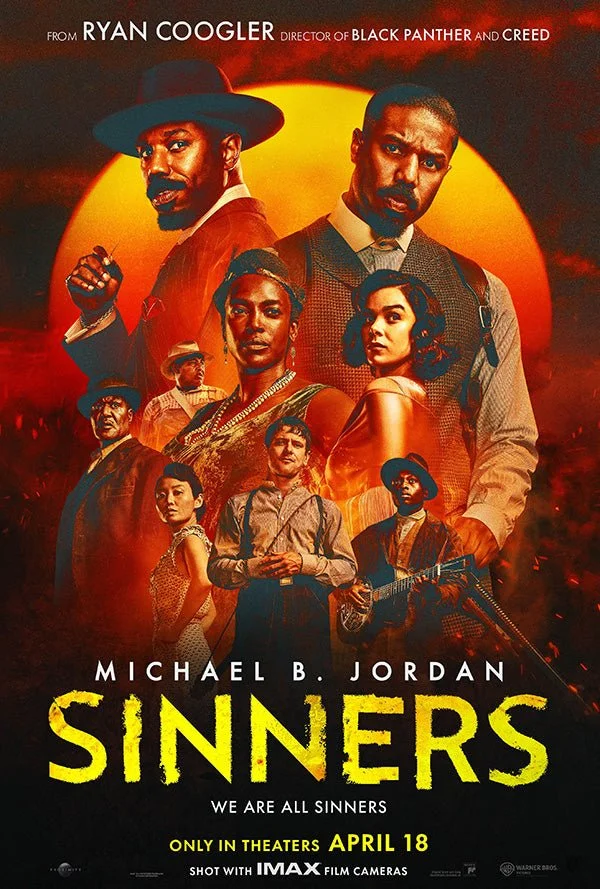
Sinners isn’t just Sammie’s story; it’s his cousins’ too. Smoke and Stack are Sammie’s older cousins, just back from Chicago. They want to open a juke joint right there in Clarksdale. A place where people gather to listen to music and live the life they fight so hard to earn sounds like heaven to Sammie. Immediately, he’s on board with the vision.
A place that’s safe, sacred even, where they don’t have to earn the right to exist. Imagine that.
It doesn’t take much convincing to get the right folks involved in this venture. After all, who is anti-Eden? Who votes no on respite? What kind of person refuses to live life? You know who? The people who don’t understand the purpose of the juke joint. This space is meant for people to connect, not just to each other, but with that life force they must suppress simply to stay alive outside. The place is the portal; the music is the mechanism to freedom.
When the juke joint is finally set up, the door is being watched, the food is being prepared, and Sammie has the floor, that’s when it happens: Sammie’s reminded to tell everyone where he’s from and who he is before he begins. And so he does. With his voice and his guitar, he proceeds to rip the space-time continuum and show us where we come from, where we’re at, and where we’ll be someday. All of us witnessing this moment have no choice but to get swept up in the energy. What a gift.
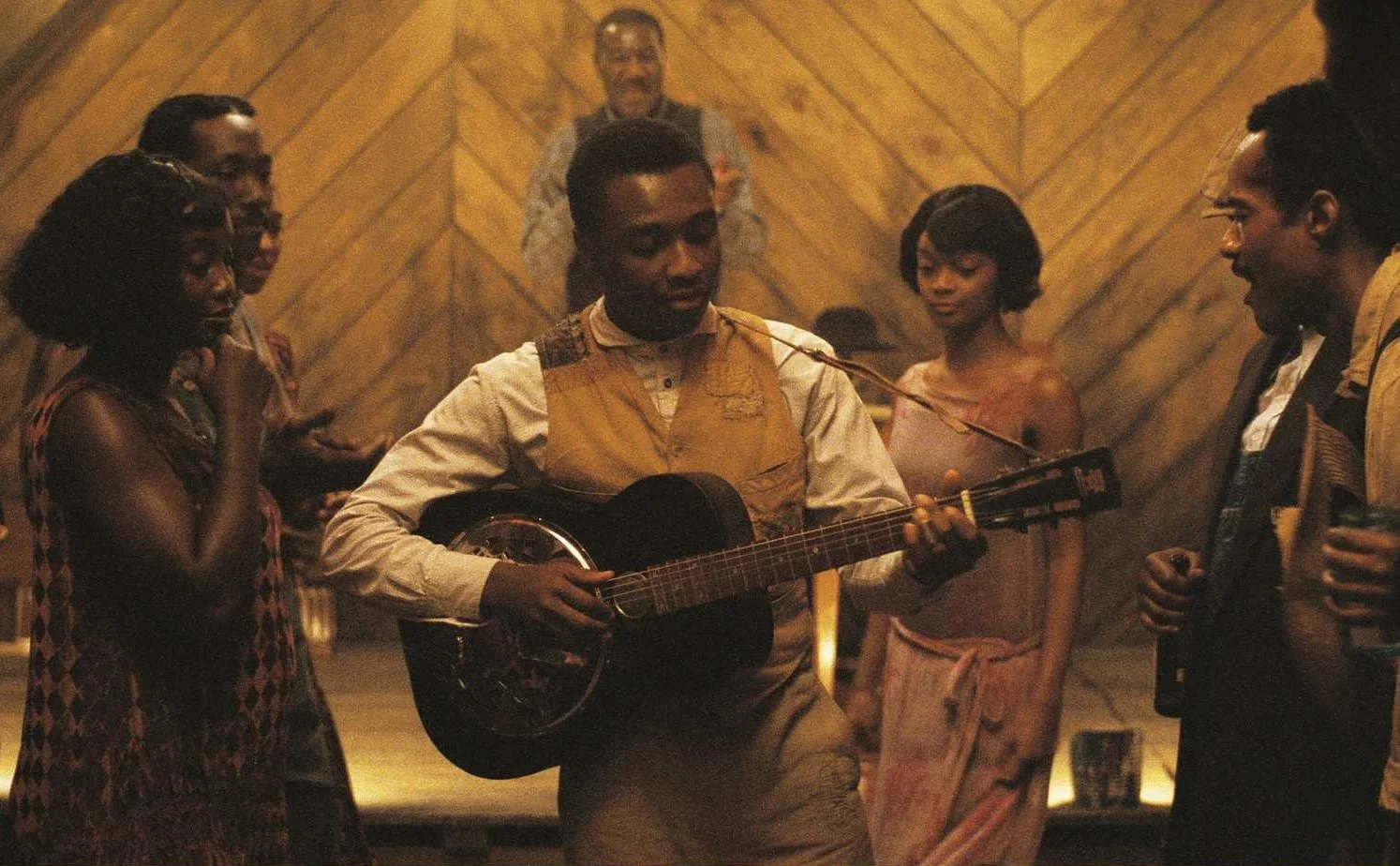
The thing about Sammie’s music—any good, soulful music, really—is that it reaches beyond the walls of the room. In our case specifically, it reaches outside the walls of the juke joint, and that’s where it all goes sideways.
There are vultures circling. Sure, they’re metaphorical, for now. That doesn’t last long, though. The metaphorical vultures soon turn out to be actual vampires. They’re bloodsuckers, taking from everyone they encounter, consuming their joy, culture, provenance, and even a bit of their soul.
With the arrival of Remmick, the outrageously charismatic vampire, comes the offer of seamless assimilation. It sounds good on the surface, but Remmick is playing the long game. He doesn’t just want their blood. He wants access to the gift that is Sammie’s music. He’ll do anything to have it because he, too, wants to feel connected to something bigger than himself. He, too, had colonizers come to his home, kill his people, and obliterate his culture. Remmick is just looking to get some of that back, and the only way to do that is via Sammie’s music. It’s clear he understands something visceral about the story of Sammie’s people, but what he hasn’t yet grasped is that survival didn’t come through assimilation. What Sammie is saying through his music, every time it connects, is:
Don’t assimilate; celebrate, for it will be your salvation.
Coogler’s approach to directing is impressively detail-oriented. Every little aspect of the moviemaking process is very obviously considered and sometimes given a very deep-rooted meaning. There would be no other way to successfully put together a vampire movie that also happens to make statements about American racism, culture, provenance, U.S. history, belonging, unity, and solidarity without so much as uttering those words.
The religious imagery strikes early, and it’s immediately questioned with flashes of Remmick superimposed over the preacher in the opening scene. I cannot express how quickly and effectively that editing drew me into the story. What do you mean the church could be dangerous, Mr. Coogler? I am intrigued. And then this man hits me with a snake that conjured up thoughts of an Eden where Black people could feel safe in 1930s Mississippi. Then boom, we’re in the juke joint and it all falls into place.

By the time Remmick shows up, we’re already braced for all kinds of meaning and layered filmmaking. What we’re not ready for is the rizz, at least I wasn’t. This man gives an entire impassioned and rather convincing monologue about the benefits of assimilation, and I was wide-eyed buying into it. ME—the one who ALWAYS says assimilation is a scam—I was on the cusp of buying what Remmick was selling. “Outrageous!” I thought when I first noticed what was happening, and then I followed that up with, “Outrageously good filmmaking, genius even.” And yeah, I was right about that.
While Remmick is charismatic to the point of seduction, he is not inherently good. What he wants is to take—indiscriminately. If anyone accepts his offer of artificial unity, they’re effectively giving up a part of their soul. With his version of “unity,” there is chaos, violence, and hierarchy. This is a song we should all be familiar with, but when the mask is on tight, you can’t see it so plainly. What Ryan Coogler does with Remmick is let him seduce us and then let the mask slip, allowing us to see him for what he really is: a parasite.
Coogler’s message is clear. It’s not sin; it’s life. Sex, music, dancing, female pleasure specifically, desire, joy, community, occasional indulgence—these are not sins. These are evidence of a life well-lived.
Sinners is beyond impactful; it’s pure unadulterated fun while also managing to make statements about a litany of social issues, which I won’t get into because Ryan Coogler was so effective at doing it in the film. Coogler nailed it to the wall. This leads me to my next point: the rewatchability of this movie is insane. You’re going to see something new with every viewing and connect a new dot every single time. Lastly, none of this would have come across so precisely or landed as both horror and drama without two outstanding performances from Michael B. Jordan. If you’ve got an open mind and an appreciation for layered moviemaking, this is the one for you. If you don’t have a favorite genre but will watch anything interesting, this is for you. If you love music, this is for you. If you love history, this is for you. If you like good movies, well, you know the rest. And if you disagree, my comment section is always open.
P.S. Delroy Lindo was robbed.