
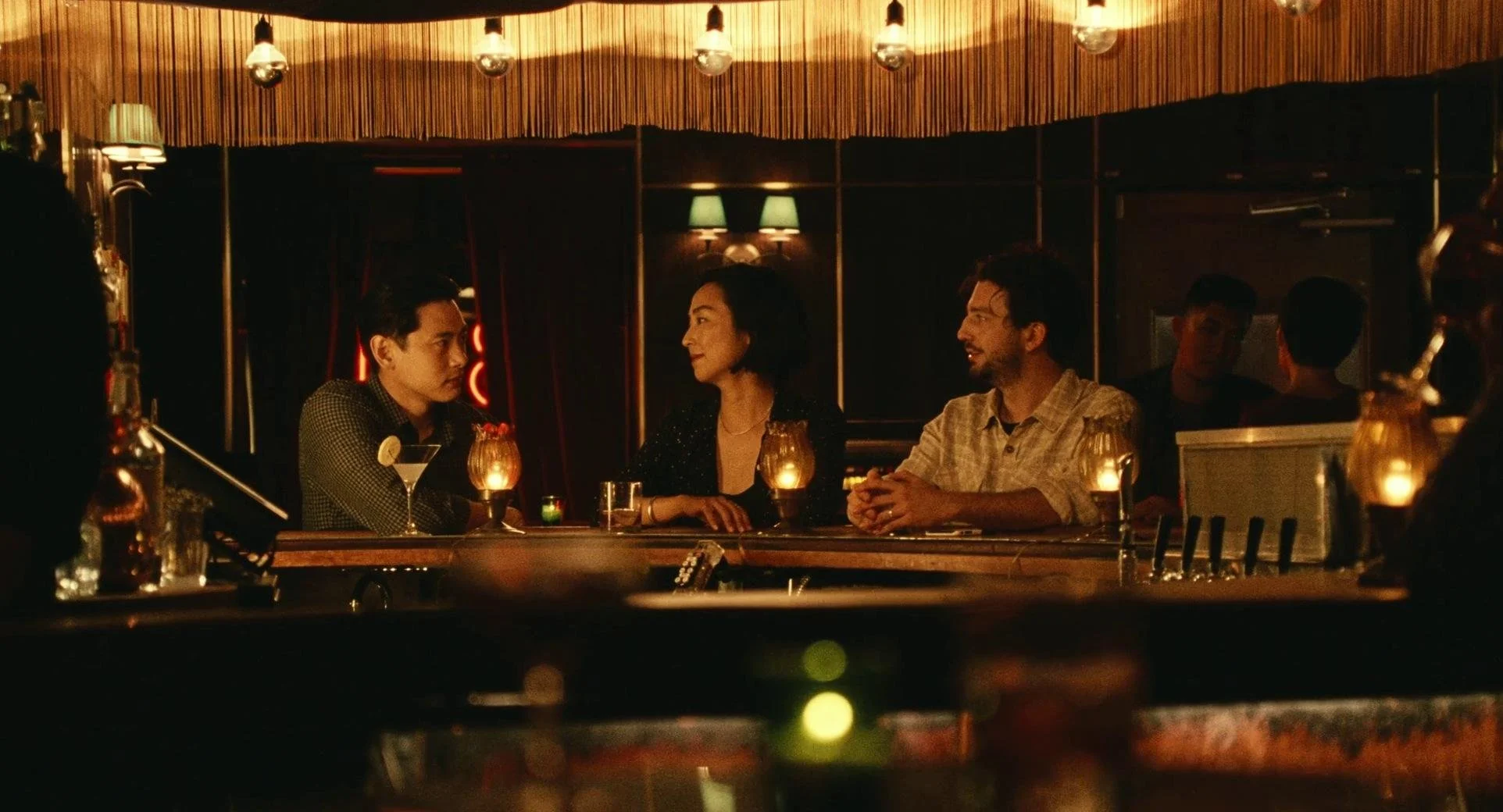
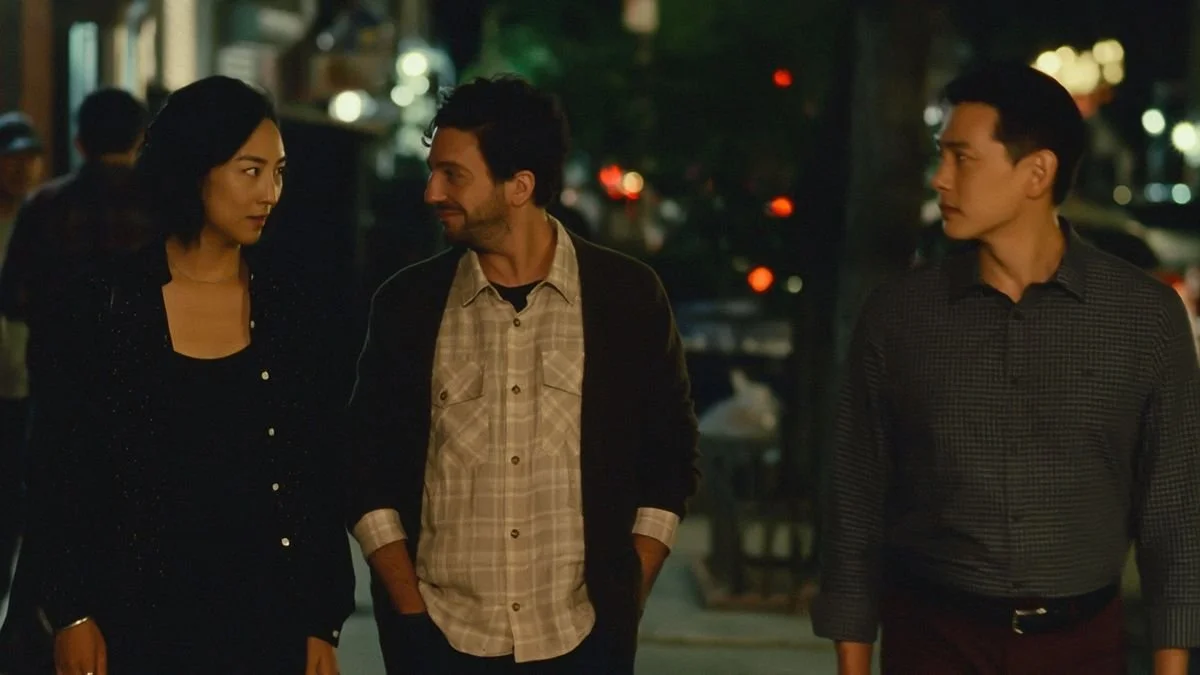
Past Lives opens in a New York City bar awash in amber light. It’s 4 a.m. There are three people sitting at this bar. Another couple is sitting across from them, on the opposite side. We are perched on the shoulders of this other couple, who are knee-deep in people-watching. We’re listening to them debate who these three might be to one another, how they’re related, what they mean to one another, how they fit, where they fit. And then, just as we begin to settle into being flies on the wall, Nora turns to face us. She’s inviting us to not know together.
And so not knowing is where we begin. Who these three people are is a mystery to all of us: you, me, them. We’re all sitting here, at this ungodly hour, pondering life—not just life but the moments that lead to us sitting at this bar right now. With that, Celine Song (director) transports us to the other side of the planet, to one of Nora’s earliest life-defining moments. We’ve gone from NYC to Seoul, during a time when Nora was just a kid and her name was Na Young. Back in Seoul, Na Young was the overachieving daughter of a filmmaker and artist. By all accounts, their little family was a success. Na Young even had a best friend, Hae Sung. He was her competition and her comfort. What more could a girl ask for? But then one day, Na Young’s parents decide to move the family from Korea to Canada, not because they are running from something, but because they want to build something new, and the only way to do that is to make room and challenge themselves.
Na Young challenges herself by competing to be the best in her class in Seoul. She’s even justified her abrupt move to Canada by telling classmates that she’s leaving because “Koreans don’t win the Nobel Prize for literature.” She’s mentally preparing for the move and doing whatever she can to view this change as an opportunity, not a loss. This is her overachiever way. Nevertheless, every now and again, Na Young looks over at her best friend and feels a curious pang. It seems she’s too young to understand what exactly she’s feeling. Na Young is smitten and sees a whole lot of impending change on the horizon. And then one day, it’s over. Na Young has become Nora, and she and her family have immigrated to Canada. The years pass, and Nora the Canadian has decided she’s going to become Nora the American—and not just any American, Nora the New York playwright.

Greta Lee brings Nora to life in a quiet but powerful way. Nora is going through a million emotions a minute when her former best friend, who knew her before she knew herself, pops back into her life. Lee, instead of riding that wave of intense emotion into a melodramatic performance, went the other way with it. Greta Lee takes life-altering emotion and condenses it into sustained eye contact. In fact, there are decades of conversations being exchanged any time Nora and Hae Sung look at one another. One shift in gaze, a wry smile, a sideways glance—these are the micro moments Lee is utilizing to get across decades of possibility, longing, and evolution. Lee gives Nora the space to be a complicated woman, someone who loves her life but still wonders about the path she did not take—could not take. Lee seems all too aware of what someone like Nora would have to give up in order to live the life she aspired to, so she gives the performance incredible dramatic weight by way of each glance, smirk, and grimace.
Teo Yoo gives us a Hae Sung that is quiet, reserved, and even a little awkward. With Nora, it feels like she’s driven by her ambition to accomplish. Hae Sung, on the other hand, is moved to carry the history of a life they never got the chance to live, out of respect and loyalty. While Greta Lee’s performance comes across her entire face, Teo Yoo focuses on the eyes. Every thought, hope, disappointment, and ache is contained there. The quiet intensity that Yoo ushers forward with his eyes creates what feels like a direct connection to those two kids who were smitten and felt like they’d know each other forever. Yoo mirrors back every last bit of emotion that Greta Lee brings forth through Nora. Those wordless conversations are not one-way streets. Those exchanges are full-bodied dialogue because they come across so strongly through Teo Yoo’s eyes.
John Magaro as Arthur is deeply empathetic and slightly uncomfortable. Magaro’s performance provides the somber grounding necessary to convey the depth of the never-fully-realized love story between Nora and Hae Sung. Arthur loves all of Nora because he is the one who sees her completely. He knows Nora had plenty of lives before him. At night, he hears her speak an entirely different language when she sleeps. He knows there are places she inhabits that he cannot reach. He knows she’s complicated. We all contain multitudes, right? We’ve all been a million versions of ourselves before becoming who we are now. Arthur not only sees all of Nora’s versions, he appreciates them because they make her who she is today. He loves her multitudes.
Magaro’s performance is gentle and nuanced, a perfect complement to both Teo Yoo and Greta Lee. Of our three main characters, Arthur is the most emotionally intelligent. Initially, however, I was reading him as a pushover, a weakling. Turns out, I could not have been more wrong about Arthur. Magaro expertly channels deep vulnerability throughout his performance to reveal Arthur as a study in quiet masculinity. The nervous energy, the clingy physicality: Magaro uses just the right combination to make us underestimate Arthur before revealing him to be the kind of character some of us (me, I’m talking about me) wouldn’t mind growing up to be.
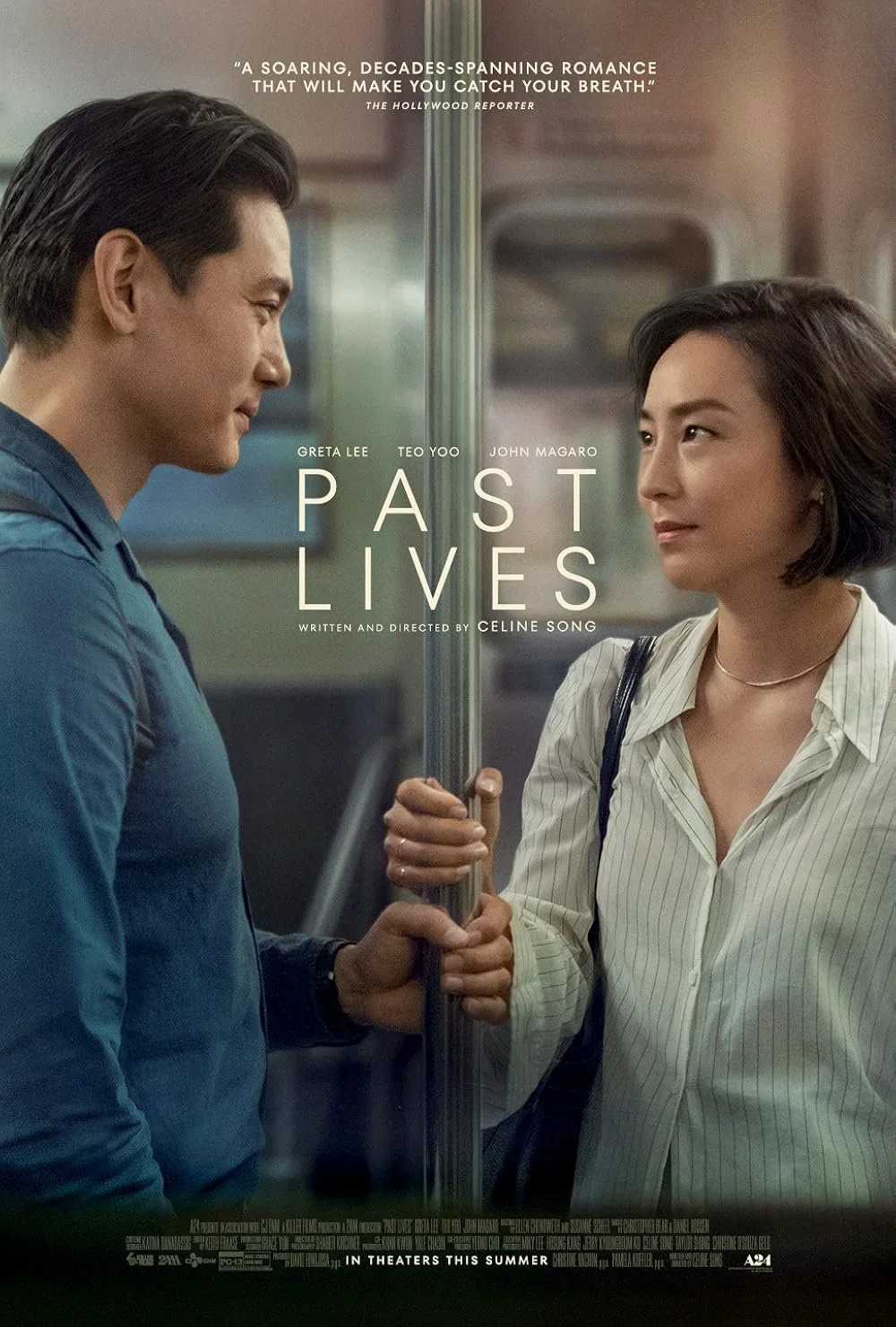
It’s a lot. I know. But here’s the thing: Past Lives is one of the quietest movies I’ve seen lately. There are no chase scenes, no melodramatic declarations of love, no explosive anger. At first glance, the movie comes across as muted and maybe even too quiet. The problem with that interpretation is that decades of longing, nostalgia, and unspoken conversations are unfolding through sustained eye contact on a simple subway ride. Past Lives is more about the the feeling than the dialogue. Sure the words matter. Words always matter, but what Celine Song has us focus on is the implication. Song builds an entire world from the glances exchanged between our main characters. She insists we feel the crushing energy that radiates when the world cracks in half and we realize we actually can’t go back.
Celine Song creates an intimate atmosphere where information exchange is always happening, no matter how quiet the scene or how slow the pace. She pieces together the story of a woman, extraordinary but a woman like any other. Nora wonders about the lives she never got the chance to live. Her mind lingers on the choices she didn’t make. Sure, it hurts a little. Of course it hurts to look back on a life that could have been. Thank God we took the right path, right? We chose right, right? RIGHT?! Of course we did. Maybe. What Celine Song is doing with Past Lives is letting us turn around real quick to look at where we used to be and linger on the what if.
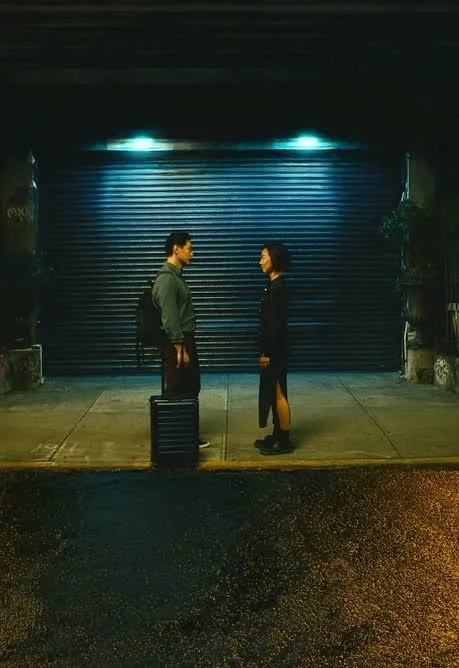
Past Lives lives in the collection of maybes, what-ifs, and daydreams that we all carry. Sure, the movie is about two absurdly good-looking people who used to be smitten childhood friends who managed to hang on to the memory of one another across decades and thousands of miles. But Past Lives is also about the pain of standing there quietly and looking back at a version of yourself that you can’t bring on the trip from here on out. Goodbyes are hard, but they’re even harder when you’re saying them to versions of yourself that used to make up the bones of who you were. The beauty lies in the strength to continue honoring our past lives despite the goodbyes, in sitting with the ache of what never had a chance to be while embracing the person who emerged from all that experience.