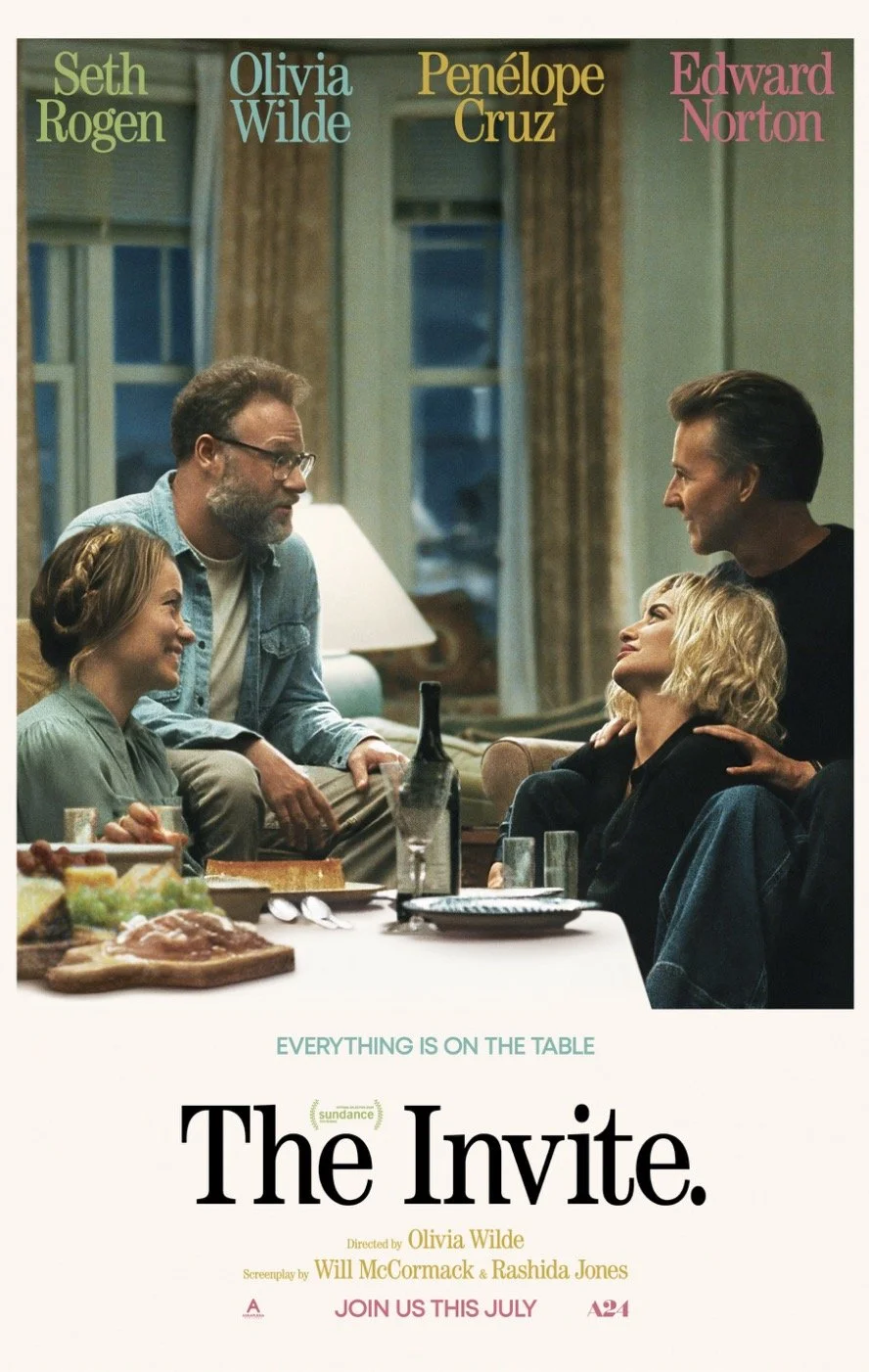

I took a trip back to Virginia from Southern California recently. Long plane rides are optimal for movie watching and so I took my time with that United in-flight entertainment menu on both flights. I actually found quite a few movies I’d been meaning to watch but kept putting off. Life is crazy out there right now. Anyway, brace yourself for the barrage of incoming reviews. Today’s selection: The Invite.
We are introduced to Joe on his evening commute. He’s navigating the streets of San Francisco carrying a bike, on the bus—I repeat, in San Francisco. If you’ve spent any time on those streets—car or not, bike or no bike—you know it goes from beautiful to terrifying lickety-split. By the time he makes it to his building, into the elevator, up to his door and into his apartment, we’re all exhausted.
That’s our introduction to Joe’s life: exhaustion. By the time Joe’s neurotic wife Angela (dressed like the girl on the Swiss Miss hot cocoa package) shows up to spring a dinner party on him last minute—we simply cannot. The upstairs neighbors who have sex regularly and loudly—loud enough to keep Joe awake—are coming over and Joe does not understand why this is happening to him.
The dialogue is the movie here. Joe and Angela are inhabiting a marriage that is on its last legs. Angela comes into the room like a fragile tornado trying to get her place in order for their guests. Their guests are the far sexier Hawk and Piña. I’m sure you have questions. I did too. They will all be answered in due time.
Piña is the walking embodiment of sexual tension. Hawk is happy to be here and far too comfortable in the space. Angela is anxiety and Joe is tired. This is who we’ve got at our dinner party at the start of this film. Through the sometimes warm, sometimes vulnerable and oftentimes biting dialogue, the dynamic between the characters is exposed. One by one, they each drop their defenses just enough for us to get a glimpse of the person behind the archetype. The dialogue here isn’t poetic, cynical or overly stylized. It’s real. It comes across as authentic small talk that ends up drawing out the kind of emotional exchange where a friendly stranger who grants you a bit of their precious attention might change your entire point of view.
Pulling off that kind of emotional exchange requires some heavy lifting from the actors. I was delightfully surprised by each interpretation of our four main characters.
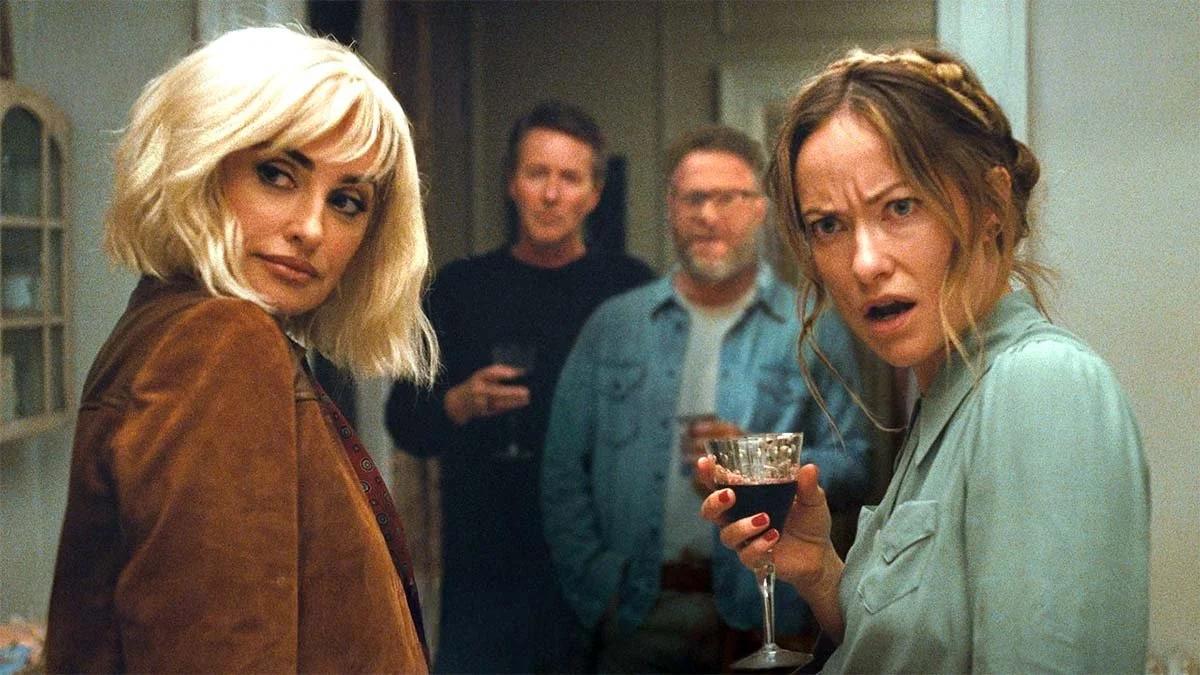
Penélope Cruz brings Piña to life with an exaggerated, almost cartoonish sexuality. The intensity of that sexual energy comes through mostly in her eyes. She’s fully aware of what she can do with those things and has clearly been doing it her entire life. Then there’s the cleavage. Cruz uses her cleavage as a prop to pull people in. It’s like the sun—you can’t stare, but you have to look. It drew us all in—Joe, Angela, me—and it will get you too. Then, just when you think this movie is going to veer into raunchiness, Cruz reshapes that sexuality and smothers you with it like a weighted blanket. Suddenly you’ve gone from aroused to deeply comforted, and you’re wondering where this is all headed.
Edward Norton creates a man who is comfortable in his own skin but has a complicated backstory that’s fairly evident the moment you look him in the eyes. Norton brings a profound sadness to a character who too easily makes himself at home in other people’s spaces. At first, Norton gives us an almost zen-like Hawk. Slowly, as the vulnerabilities of the group surface organically, he reveals the sadness that lies beneath his serene exterior. Hawk has learned to roll with the punches because when life leaves you no alternative, you become a quick study for survival.
Joe’s our Everyman. He’s you. He’s me, and we’re all tired. We’re tired of the daily grind. We’re tired of the nagging. We’re tired of our low back pain. We don’t know how we got here. And Seth Rogen makes us feel how quickly we went from aspirational musician to music teacher on the brink. Joe’s sad too, but he can’t be zen about it. He’s mad, and if he doesn’t sort it soon, he’ll end up bitter and quite possibly alone. Seth Rogen’s kind face is instantly recognizable. You want to like him as Joe, and initially you do. Well, I did. I identified with that trek home, the exhaustion, and the short fuse. As Joe’s words got sharper, Rogen’s delivery became incrementally more forceful. Turns out Seth Rogen is one hell of a dramatic actor.
Olivia Wilde personifies anxiety in a way that makes her almost jump off the screen and into your lap. Her energy gets so frenetic in spots that it’s almost too much to tolerate and reeks of desperation. One of the main sources of Angela’s anxiety is instantly recognizable to any woman who has ever been in a relationship with a manchild. Wilde brings us an anxious and manipulative wife but later reveals her to be a neglected husk trying desperately to get her soul back. We’re catching Angela right before she snaps, and all is lost for her marriage, so the stakes are high and no one is more aware of that than she is. Wilde brings Angela to life with enough complexity to make her relatable, which is surprising since she was initially so unlikeable.
When I saw The Invite on the in-flight entertainment menu, I was immediately intrigued, and since Penélope Cruz was in it, I was already sold. I was going to watch this eventually, so why not now? And I’m glad I did. I liked it far more than I expected and came away with an appreciation for some excellent dramatic acting. A dialogue-driven movie requires a little extra push from its actors, and these four were more than up for the challenge. They ceased being four big tabloid names and became Angela, Joe, Hawk and Piña. Doesn’t get much better than that, does it?